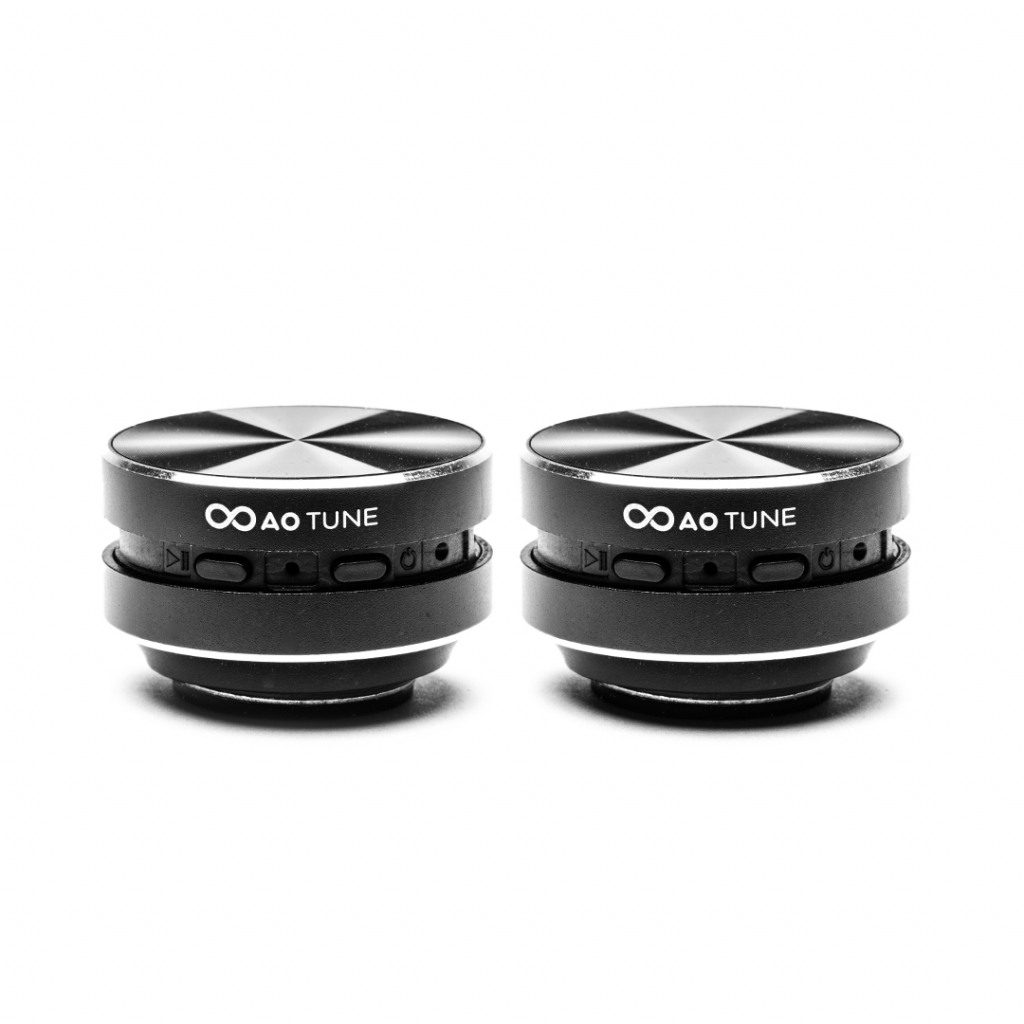
The AO Tune Negative Ion Transducers are the tuning forks of the AO Tune module. These transducers are designed and made to handle the frequencies produced in the module.
They have a permanent Si Bin power disk on the bottom to promote the si bin and negative ion benefits while using the scanner.
Si Bin and Black Tourmaline Benefits: MORE INFO | BUY NOW
• Increases stamina*
• Enhances your body’s balance and center*
• Enhances metabolism*
• Enhances your body’s immune system*
• Stabilizes your body’s electrical balance*
• Improves concentration and focus*
• Aids fatigue recovery*
• Aids elimination of bacteria*
- TWS (True Wireless Stereo) Supported
- High Sensitive Speaker Built In
- USB Type C Charging Port (not compatible with fast charger)
- Bluetooth ver: 5.0. A2DP, HFP
- Bone Conduction Transducer: 3 Watt
- Frequency Range: 120Hz – 16kHz
- Battery: 450 mAh Polymer Battery
- Working Time: 5 hours with 75% volume
- Charging Time: 40 Minutes Fully Charged
- Product Size: 40mm x 40mm x 24mm
- Product Weight: 37 grams
Charging and LED Indicator: MORE INFO | BUY NOW
Use a USB cable compatible with common USB chargers, like a phone USB charger or a car charger. (Do not use a fast charger, the charging voltage cannot exceed five volts).
When charging, the red LED will be lit. Once charged, the red LED will switch off. When Bluetooth mode is turned on, the LED will blink blue. Once paired/connected, the blue light will be solid blue.
Usage Tips:
Use a nail or pin to assist the lanyard through the slot.
The speaker will get hot if the volume is turned up at maximum level. This is a normal condition. Lower the volume slightly, and the transducer’s temperature will return to normal.
Negative ion transducers that connect with the AO Tune module. Rather than vibrating mechanically like a tuning fork, they convert the frequencies generated by the AO Tune software into physical vibrations/electromagnetic output through the transducer.
Best Uses (in my opinion): MORE INFO | BUY NOW
⭐⭐⭐⭐⭐ Pain & muscle recovery
⭐⭐⭐⭐⭐ Massage sessions
⭐⭐⭐⭐⭐ Relaxation sessions
⭐⭐⭐⭐⭐ Before sleep
⭐⭐⭐⭐⭐ Meditation
⭐⭐⭐⭐⭐ Hands-on Body Code work
⭐⭐⭐⭐⭐ While running AO Tune frequency programs
⭐⭐⭐⭐ Great after exercise
⭐⭐⭐⭐ Good before stretching
⭐⭐⭐⭐ Good after chiropractic adjustment
1. Hold one in each hand
Probably the easiest.
Run your AO Tune program.
Relax. Breathe. 10–20 minutes. MORE INFO | BUY NOW
2. Place on the body
Instead of holding them…Lay them on:
- shoulders
- low back
- hip
- knee
- calf
- abdomen
- sternum
while running the desired AO Tune program. MORE INFO | BUY NOW
3. Massage enhancement
• Run the AO Tune session.
• Place one transducer on the upper back.
• One on the low back or hip.
Massage while the frequencies are running.
That may create a relaxing experience for the client. MORE INFO | BUY NOW
4. Knee Issues
One transducer:
➡️ lateral hip / glute medius
Second:
➡️ upper calf or just above the outside of the knee
Then run the AO Tune frequency you feel is appropriate.
After 10–15 minutes: Walk.
Compare range of motion and comfort before and after.
Keeping simple notes can help you identify patterns over time. MORE INFO | BUY NOW
5. Before bed
One on:
- chest
- abdomen
or just hold both. MORE INFO | BUY NOW
Run a relaxing AO Tune program. Many users report enjoying this as part of an evening routine.
6. Meditation
One in each hand. Eyes closed. Slow breathing. 20 minutes.
7. Emotional work
You could simply hold the transducers while listening to calming music or running a relaxation-oriented AO Tune session. That can make for a peaceful transition, after emotional release work.
I would NOT do
I wouldn’t chase dozens of body locations. I’d keep it simple.
Most sessions I’d use only:
✅ hands ✅ shoulders ✅ sternum ✅ low back ✅ hips ✅ knees
What excites me most
Sessions:
- AO Scan
- Review results with the client
- Releasing trapped emotions and other imbalances
- AO Tune session with the transducers positioned comfortably
- Gentle massage or bodywork (when appropriate)
- Hydration
- Brief reassessment of how the client feels and moves
That creates a calm, structured wellness experience while staying within the intended use of the AO ecosystem. MORE INFO | BUY NOW
| Goal | Best way to use |
|---|---|
| Calm the nervous system | Hold near the ears (not touching) for 30–60 seconds each side |
| Muscle soreness | Place the stem on the muscle belly or tendon for 20–40 seconds |
| Tight fascia | Follow the tight tissue slowly with the vibrating stem |
| Joint stiffness | Touch around (not directly on) the joint |
| Meditation | Hold beside each ear and breathe slowly |
| Before AO Scan | Use 2–3 minutes first to help the person relax |
| After massage | Excellent finishing technique |
| Emotional work | Use after releasing trapped emotions to encourage relaxation (practitioner experience rather than established evidence) |
What they’re especially good for
1. Relaxing the nervous system
Many practitioners begin every session with this because people visibly relax.
Use:
- activate fork
- hold 2–6 inches from each ear
- don’t touch the ear
- let the sound fade
- repeat 3–5 times
2. Muscle pain
Instead of pressing hard…
Touch the vibrating stem onto:
- upper traps
- calves
- forearms
- hamstrings
- IT band
- glutes
Hold 20–40 seconds. MORE INFO | BUY NOW
3. Tendons & ligaments
Excellent for:
- tennis elbow
- golfer’s elbow
- Achilles
- plantar fascia
- rotator cuff insertions
Hold the stem gently against the attachment point.
4. Trigger points
Instead of digging with your thumb…
Find the knot.
Apply vibration.
Many massage therapists find this lets the tissue relax with less pressure. (This is based on practitioner experience rather than conclusive clinical trials.)
5. Around joints
For:
- knees
- hips
- shoulders
- wrists
- ankles
Don’t pound directly on bone.
Instead:
Touch around the muscles and tendons surrounding the joint. MORE INFO | BUY NOW
6. Before Body Code or Emotion Code sessions
Many practitioners like to:
- relax the client
- reduce stress
- then begin muscle testing
It can help people settle into the session. MORE INFO | BUY NOW
7. During meditation
This is wonderful.
Hold beside ears.
Close eyes.
Slow breathing.
Most people naturally slow their breathing.
8. Before sleep
A simple evening routine:
- one minute beside each ear
- shoulders
- sternum
- then bed
Where can you place them?
Good places:
✅ sternum
✅ clavicle
✅ shoulder muscles
✅ upper back
✅ neck muscles
✅ forearms
✅ thighs
✅ calves
✅ hands
✅ feet
✅ sacrum
Avoid:
❌ eyes
❌ throat/front of neck
❌ directly over recent fractures
❌ open wounds
❌ directly on implanted medical devices
❌ painful bony prominences
General medical guidance for tuning forks also recommends applying them only to healthy skin.
For knee
- Piriformis
- Glute medius
- IT band (lightly)
- Lateral quadriceps
- Hamstring insertion
- Calf
- Around the knee—not directly on the kneecap
- Hip muscles
I’d spend 20–30 seconds at each location, then walk and notice whether movement feels different.
Combine with AO Scan
One sequence that many frequency practitioners enjoy is:
- AO Scan
- SEFI
- Tuning forks
- Massage or stretching
- Water
- Gentle walking
This can create a calm, focused wellness session, though evidence for this specific sequence is based on practitioner experience rather than clinical studies.
My favorite “full-body” routine (10–15 minutes)
- Beside left ear – 30 sec
- Beside right ear – 30 sec
- Sternum
- Both shoulders
- Base of skull
- Upper traps
- Mid back
- Sacrum
- Hips
- Knees (around them)
- Calves
- Bottoms of feet
It’s a simple routine that’s easy to remember. MORE INFO | BUY NOW
What AO Tune Is
AO Tune is located within SEFI, near the bottom of the SEFI options.
It contains frequencies intended to replicate approximately 37 unique tuning forks. The categories discussed were:
- Binaural
- Planetary
- Chakra
- Organ
- DNA/RNA
- Spiritual Insights
- Auto tuning forks
Some frequencies overlap between categories.
The idea is that instead of purchasing many physical tuning forks, AO Tune generates their corresponding frequencies through the AO Scan device and, optionally, a transducer.
The SCAN Button — Probably the Most Useful Feature
At the top of AO Tune is a SCAN button.
When you press Scan, AO Tune scans through the available tuning-fork frequencies and identifies the one the system indicates your body could benefit from at that moment.
Basic workflow
SEFI → AO Tune → Scan → Recommended Frequency → Emit Tone
This means you do not need to know which tuning fork to choose manually.
Example:
The scan selected:
Auto – Clearing & Connecting — 32 Hz
The scan helps choose which tuning fork you would have selected physically.
Physical Tuning Forks vs. AO Tune
Two types of physical tuning forks.
Standard / Unweighted Tuning Fork
A standard fork has:
- a stem
- two tongs
When struck, the tongs vibrate and the frequency radiates outward.
Compare with simply playing the AO Tune frequency through the speaker of your phone, tablet, or computer.
Weighted Tuning Fork
A weighted fork has weights on the ends.
This directs more of the vibration down through the stem, allowing the stem to be placed against the body.
Examples given:
- acupressure point
- organ area
- thyroid area
- chakra area
The AO Tune transducer placed against the body functions similarly to this type of application.
AO Tune Transducer
Solex developed a larger transducer specifically for AO Tune.
It connects through Bluetooth and can be used with:
- phone
- tablet
- computer
The presenter said the bottom of the transducer contains a permanently attached SEFI power disc.
Why use the AO Tune transducer?
Regular AO:
- wired transducers
- Bluetooth transducers
can still be used.
However, the AO Tune transducer is larger and was designed specifically to deliver these frequencies over a more concentrated physical area.
You can use what you already have.
The dedicated AO Tune transducer is an optimization rather than an absolute requirement.
Regular Audio Transducers vs. AO Transducers
Commercially available transducers may actually be better for music, because they’re designed for high-fidelity audio. MORE INFO | BUY NOW
AO transducers are designed differently because their purpose is delivery of specific frequencies rather than high-fidelity music reproduction.
So the distinction is essentially:
Music transducer → optimized for music/audio quality
AO transducer → optimized for specific frequency delivery
Waveforms
AO Tune allows you to change the waveform used to deliver the frequency.
Sine
Described as feeling more soothing.
Square
Produces a distinctly different sensation/sound.
Triangle
Also described as soothing.
Sawtooth
This may be especially effective for delivering the frequency/message, although users may find it less relaxing.
You can change the waveform while the frequency is running.
Intensity / Volume
The volume control changes the intensity of the frequency through the transducer.
Lower-frequency tones may require increasing the volume/intensity to feel them more strongly through the transducer.
Lower frequency → may need higher volume/intensity
You can adjust it based on the individual and application.
Emit Tone
Once you’ve selected a tuning-fork frequency, press:
Emit Tone
The frequency will then be transmitted.
Unlike a physical tuning fork—which has to be struck again after its vibration fades—the AO Tune frequency can continue until you stop it.
They also showed timed options such as:
- 30 seconds
- 2 minutes
- 5 minutes
So you don’t necessarily have to manually stop the frequency.
Binaural Frequencies
Binaural applications require two transducers.
Different frequencies are delivered through the two sides and the brain perceives/resonates with the difference/intermediate effect.
Gamma — 111 Hz
Positioning the two transducers:
- front and back of the head, OR
- on opposite sides of the head
Gamma is associated with:
- focus
- creativity
- getting a lot accomplished
Schumann
Schumann frequency is associated with:
- grounding
- balancing with the Earth’s frequency
Suggest holding/placing the two transducers around the ears/head area.
Planetary Frequencies
The planetary section includes frequencies associated with:
- Earth
- Pluto
- Mercury
- other planets/celestial bodies
- Schumann frequency
The planetary-frequency system to German researcher Hans Cousto.
- Centering
- Flower of Life
These aren’t planetary frequencies; Flower of Life is described as a sacred-geometry frequency.
Planetary frequencies are being used by various practitioners for different purposes.
Chakra Frequencies
AO Tune also contains frequencies organized by chakra. MORE INFO | BUY NOW
Some chakra frequencies overlap with frequencies found in the planetary section.
Run a scan → identify a chakra of interest → go to AO Tune → Chakra → select that chakra’s tuning-fork frequency → emit
This is a convenient way to pair AO Scan information with the AO Tune frequency library.
Organ Frequencies
AO Tune contains tuning-fork frequencies associated with different organs.
Examples include:
- heart
- liver
- pancreas
- thyroid
Suggested workflow
If a Comprehensive scan highlights an organ/system, go to:
SEFI → AO Tune → Organs
Then find the corresponding frequency.
For physical transducer placement, place it around the anatomical area associated with that organ.
DNA / RNA Frequencies
AO Tune also contains a DNA/RNA section.
Some of these frequencies correspond with things such as:
- amino acids
- biological components
If a particular item appears during a scan, it might indicate something such as a deficiency.
The frequency is intended to provide the body with a frequency/message associated with its “natural state.”
Spiritual Insights
Another category is Spiritual Insights.
Examples include:
- pineal gland
- spiritual awakening
- meditation
- spiritual/energy work
This is good particularly for people already using meditation or energy-work practices.
Auto Tuning Forks
There are four Auto frequencies: MORE INFO | BUY NOW
- 32 Hz
- 64 Hz
- 128 Hz
- 256 Hz
These are essentially the musical note C across four octaves.
The name is linked to historical osteophonic applications of tuning forks, including the historical use of vibration when evaluating possible bone fractures.
Using the Speaker Without a Transducer
This is useful because you can use AO Tune without the special transducer.
If you play the frequency through your:
- phone speaker
- tablet speaker
- computer speaker
Compared this to striking an unweighted tuning fork and allowing the sound/frequency to radiate into the surrounding area.
Using the transducer against the body is compared instead with using a weighted tuning fork to transmit vibration directly into an area.
So the distinction was:
Speaker → frequency into surrounding environment
Transducer → localized physical frequency/vibration delivery
When Should You Use AO Tune?
There is no required time of day.
It could be used:
- morning
- afternoon
- evening
- before bed
- multiple times throughout the day
Recommendation is essentially to use it whenever you feel drawn to use it or want to run the AO Tune scan. MORE INFO | BUY NOW
AO Tune Quick-Start Routine
Follow this very simple routine:
STEP 1 — Open SEFI
↓
STEP 2 — Scroll to AO Tune
↓
STEP 3 — Press SCAN
Don’t worry about knowing all the tuning forks yet.
↓
STEP 4 — Note which frequency AO Tune selects
Look at its category and name.
↓
STEP 5 — Choose your delivery method
Speaker: play the tone through your device.
Transducer: use a compatible transducer for localized physical vibration.
↓
STEP 6 — Select a waveform
For a beginner, Sine or Triangle may be the simplest starting choices based on the presenters’ description of them as more soothing.
↓
STEP 7 — Press EMIT TONE
↓
STEP 8 — Adjust volume/intensity
Especially with very low frequencies.
↓
STEP 9 — Choose duration
Examples demonstrated included 30 seconds, 2 minutes and 5 minutes.
↓
STEP 10 — Stop when finished and note your experience
You do NOT have to understand all 37+ tuning-fork frequencies first.
The easiest starting point is:
SEFI → AO Tune → SCAN → let the software identify a frequency → Emit Tone
Then, as you learn more, you can begin intentionally choosing Organ, Chakra, Binaural, Planetary, DNA/RNA, Auto, etc.
That makes AO Tune much less overwhelming than looking at all those options and wondering, “Okay…which one am I supposed to use?”