Viruses & Viral Frequencies
Understanding viral frequencies
Understanding how viral frequencies are represented within the AO Scan Vitals report.
- AO Scan identifies frequencies rather than diagnosing viruses or diseases.
- The software is designed to identify the closest frequency match within its database.
- A viral frequency may appear even when a person has never knowingly had that particular virus.
- Some frequencies may appear out of balance initially but return to balance following optimization.
- Other individuals may show persistent viral frequency imbalances.
2. Big V vs. Little V
The concept of a Big V versus a Little V to explain why a viral frequency may appear.
| Big V | Little V |
|---|---|
| Potentially associated with an actual virus | A frequency resembling a viral frequency |
| May relate to a current viral condition | May relate to a past exposure |
| May warrant further medical investigation | May represent the closest frequency match in the software |
A viral frequency appearing on an AO Scan does not necessarily mean the individual currently has that virus.
3. Examples of viral frequencies
Hepatitis
Example: hepatitis frequencies may appear in individuals who:
- Previously had hepatitis.
- Received hepatitis vaccinations.
- Have a frequency resembling the hepatitis frequency in the database.
Herpes simplex virus (HSV)
Individuals who experienced cold sores during childhood may continue to show herpes-related frequencies.
Herpes simplex viruses can remain latent within the body following an initial infection.
Varicella-zoster virus (VZV)
This is the virus responsible for both chickenpox and shingles.
Pay particular attention when the following frequencies repeatedly appear together:
- Herpes simplex
- Varicella-zoster
- Epstein-Barr virus (EBV)
Epstein-Barr is like a “sniper” that can remain in the body and potentially contribute to other imbalances.
Address these frequency patterns proactively through optimization, detoxification and immune support.
Shingles is caused by the reactivation of the varicella-zoster virus.
Epstein-Barr virus (EBV)
Epstein-Barr belongs to the herpesvirus family and can remain latent in the body following infection.
From the AO Scan training perspective, recurring Epstein-Barr frequencies may be something a practitioner wants to observe alongside other recurring frequency patterns.
Coronavirus
Possible interpretations include:
- Previous coronavirus infection.
- Previous exposure.
- Vaccination history.
- A current frequency imbalance.
- A frequency resembling coronavirus within the software database.
4. Seven possible reasons viral frequencies appear
This is one of the most important sections to remember .
A viral frequency may represent:
- A past virus – The individual previously experienced a viral infection, such as influenza.
- Residual damage – A previous infection may have affected the lungs or other areas of the body.
- Cellular memory – The brain recognizing frequencies associated with previous illnesses, such as shingles.
- Something developing – A frequency may relate to a developing viral condition.
- A shift occurring within the body – A change in the body’s frequency patterns.
- The closest frequency match – The software identifies a frequency resembling one of its stored blueprint frequencies.
- A combination of the above – Multiple factors may contribute to the frequency appearing.
5. Understanding optimization
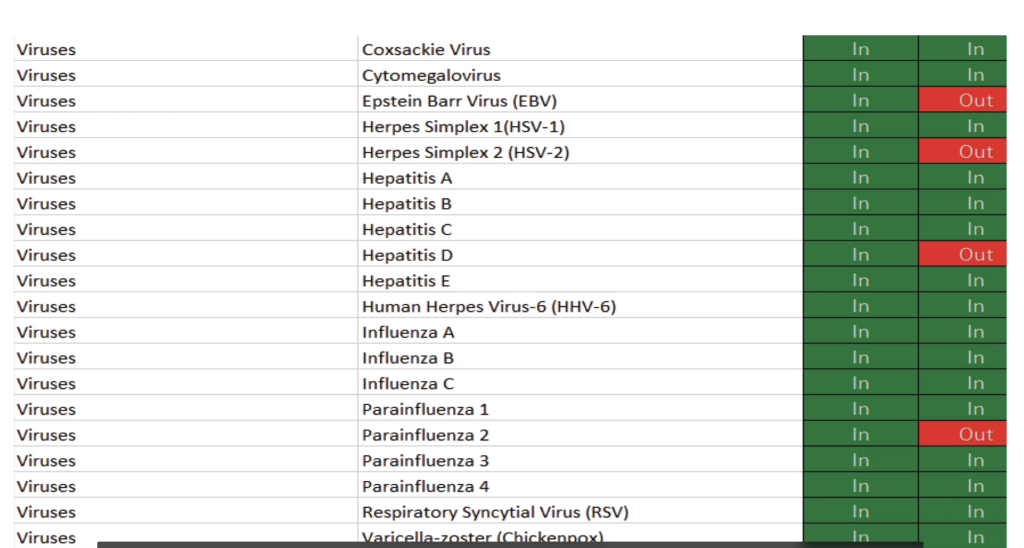
An individual whose viral frequencies were initially out of balance but appeared balanced after optimization.
From a practitioner perspective, observe:
- Initial Vitals results.
- Post-optimization results.
- Frequencies that repeatedly appear.
- Patterns across multiple scans.
- The client’s previous health and vaccination history.
- Other related frequency imbalances.
6. Questions to consider as an AO Scan practitioner
When reviewing viral frequencies, consider:
- Why might this frequency be appearing?
- Has the client previously experienced this virus?
- Has the client received a related vaccination?
- Is this a recurring frequency or an isolated finding?
- Are other related viral frequencies appearing simultaneously?
- Could this be the closest frequency match rather than the actual virus?
- Does the client have symptoms that warrant medical evaluation?
7. Quick viral reference chart
| Virus | Known clinical association |
|---|---|
| Herpes simplex virus 1 (HSV-1) | Commonly associated with oral cold sores |
| Herpes simplex virus 2 (HSV-2) | Commonly associated with genital herpes |
| Varicella-zoster virus (VZV) | Chickenpox and shingles |
| Epstein-Barr virus (EBV) | Infectious mononucleosis; lifelong latency |
| Hepatitis A | Liver infection |
| Hepatitis B | Acute or chronic liver infection |
| Hepatitis C | Acute or chronic liver infection |
| Influenza virus | Respiratory infection |
| SARS-CoV-2 | COVID-19 |
8. Key points to remember
It is all about the frequencies.
Viral frequencies are educational, not diagnostic.
A viral frequency can be a Big V or a Little V.
The software identifies the closest frequency match.
Past infections and vaccinations are possible interpretations.
Viral frequencies may represent past conditions, cellular memory, developing conditions, bodily shifts, blueprint frequency matches or a combination.
A person does not necessarily have the virus that appears on their scan.
Primary takeaway: When a viral frequency appears, do not automatically assume the client has that virus. Consider the various possible interpretations mentioed, observe recurring patterns, and use the information as an educational starting point rather than a diagnosis.